

Reclaiming Life Through Minimally Invasive Cancer Treatment
Finding Hope After Conventional Medicine Failed
Vera, a 71-year-old Canadian, shares an important truth about her journey battling synovial sarcoma: her government’s palliative care program was preparing her family for the end. Then, after receiving treatment at a specialized cancer center in China, everything changed. Six months later, when Canadian welfare services returned for their routine visit, Vera’s condition had transformed so dramatically that she was no longer classified as a terminal patient. “I am very happy!” she exclaimed when reflecting on this remarkable reversal.
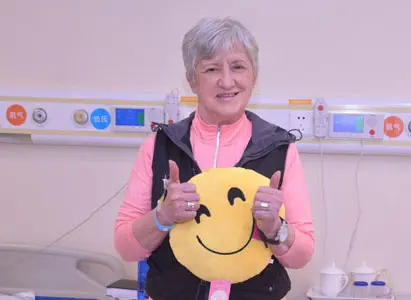
Her story began decades earlier. At age 40, Vera discovered a small lump on her left neck, roughly the size of a soybean. Preoccupied with work and family responsibilities, she dismissed it and did not seek medical evaluation. Twelve years passed before the mass enlarged significantly enough to warrant clinical attention. The diagnosis came as a shock: left neck synovial sarcoma at stage II.
The Cycle of Surgery and Recurrence
Following her local physicians’ recommendations, Vera underwent surgical removal of the tumor. According to standard treatment protocols, early malignant tumors are typically followed with chemotherapy and radiotherapy to prevent recurrence and metastatic spread. However, Vera was reluctant to proceed with these systemic treatments, having witnessed their severe side effects—particularly nausea and vomiting.
Her decision to decline chemotherapy and radiotherapy came with a high price. Over the next 18 years, the tumor returned four times, requiring three additional surgical interventions. By the fourth operation, the mass had grown to the size of a cabbage and had begun to rupture spontaneously, causing continuous bleeding. The blood loss became so severe that Vera collapsed from profound hypotension. In her own words: “I passed out and hit the ground. My forehead broke and I received 12 stitches. When I woke up, blood covered the entire floor—it looked like a crime scene.”
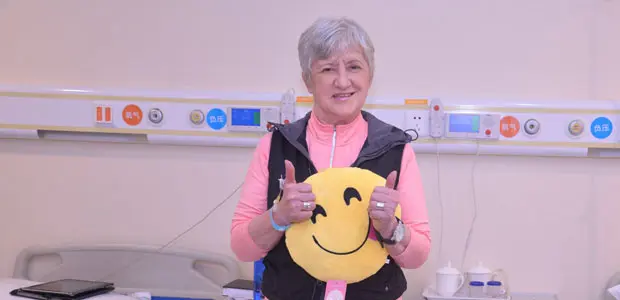
At this point, her local doctors delivered devastating news: there were no remaining treatment options available. Vera felt trapped between accepting a hopeless diagnosis and finding an alternative path forward.
The Turning Point: Discovering Minimally Invasive Options
As the mother of four children, Vera possessed an inner strength born from familial responsibility. Her husband had died of colon cancer during her middle years, and she had already endured tremendous loss. Rather than surrender to despair, she resolved to explore every remaining possibility. Through online research, she discovered St. Stamford Modern Cancer Hospital Guangzhou. When she contacted their consultation team, they presented information that resonated with hope: the facility offered 18 different methods of minimally invasive cancer treatment—approaches her local physicians had never mentioned.
This discovery set in motion the journey that would transform her life.
Comprehensive Assessment and Treatment Strategy
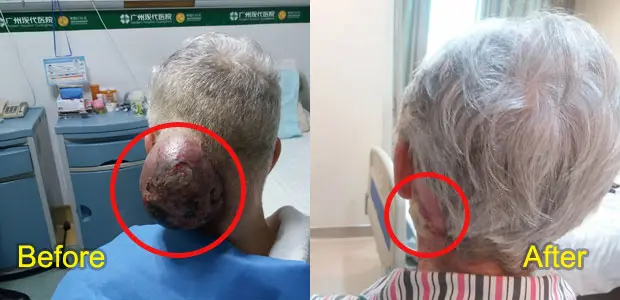
Upon arrival in Guangzhou, Vera’s physical condition was precarious. Her tumor had grown to approximately 12 centimeters by 10 centimeters and was actively bleeding. Beyond the local tumor burden, she suffered from multiple systemic complications: dangerously low protein levels, severe anemia, and balance problems from her weakened state.
The hospital’s Multidisciplinary Team (MDT)—comprising specialists from various disciplines—convened to analyze her case thoroughly. They recognized that Vera had progressed to advanced stage disease with lymph node involvement. Conventional surgery was no longer an option, and her cancer had proven unresponsive to chemotherapy and radiotherapy. Most critically, the ongoing hemorrhaging posed an immediate life-threatening risk. The MDT formulated an integrated treatment strategy utilizing three complementary minimally invasive techniques.
The Three-Pronged Minimally Invasive Approach
Interventional Therapy: This image-guided procedure involves threading a specialized catheter into the body to deliver concentrated chemotherapy drugs directly to the tumor site. By simultaneously cutting off the tumor’s blood supply and flooding it with high-dose anticancer medications, the technique destroys cancer cells while minimizing exposure to healthy tissue. The medication concentrations are significantly higher than systemic chemotherapy, yet side effects remain minimal because the drugs act locally rather than throughout the entire body.
Microwave Ablation: This technique uses targeted microwave energy to generate intense heat within the tumor, causing cancer cells to denature and die. Vera experienced only mild warmth during the procedure and reported no significant discomfort.
Particle Implantation (Seed Implants): Radioactive seeds are precisely positioned within the tumor under imaging guidance. These seeds deliver sustained radiation therapy directly to cancer cells over time, achieving robust local control with minimal impact on surrounding normal tissues.
The combination of these three approaches—interventional therapy to control bleeding and deliver chemotherapy, microwave ablation for direct thermal destruction, and particle implants for sustained radiation—created a synergistic effect against Vera’s resistant cancer.
Remarkable Clinical Response
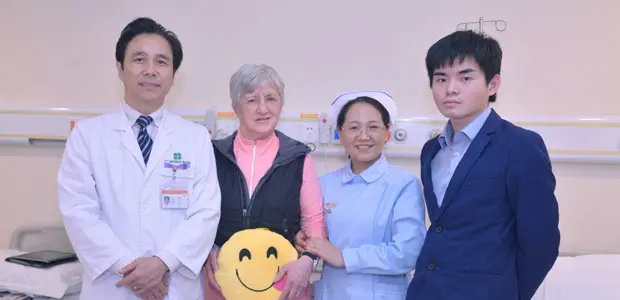
The results were extraordinary. Under the direction of Dr. Ma Xiaoying, the medical team documented significant improvements following the initial minimally invasive treatments. The life-threatening hemorrhage was rapidly brought under control, and the tumor began to shrink substantially. Laboratory markers reflecting Vera’s nutritional and oxygen-carrying capacity—hemoglobin and albumin levels—returned to normal ranges, indicating restored overall health.
By March 2018, Vera had made five trips to the hospital for treatment. Her comprehensive regimen included six cycles of interventional therapy, three cycles of microwave ablation, and two courses of particle implantation. The cumulative results spoke for themselves: her neck tumor had shrunk by 90 percent. She gained 10 pounds, indicating restored appetite and nutritional status. Most importantly, her life returned to normalcy—she could resume her role as a mother and grandmother without the constraints of advanced cancer.
A Mother’s Gratitude and Renewed Purpose
Vera’s gratitude extended far beyond the medical team’s technical expertise. She expressed deep appreciation for the human compassion she received—from nurses who cared for her with dignity, to translators who ensured she never felt isolated by language barriers, to Dr. Wang who frequently offered encouragement with a reassuring hand on her shoulder. These gestures communicated a message her local Canadian physicians had implied but never spoken with certainty: she was worth treating, regardless of age.
“The Canadian doctor told me I was too old to be treated,” Vera reflected. “But I have never heard that here. I am very grateful to all the staff. Dr. Wang especially made me feel that everything will be okay. I feel that everything is going to be fine and hopeful in the future.”
When Vera returned to Canada after her successful treatment course, her family and her original medical team were stunned by the dramatic transformation in her neck. The visible shrinkage of her once-massive tumor provided undeniable proof that minimally invasive approaches could succeed where conventional methods had failed.
Today, Vera’s story stands as testimony to the power of perseverance, the importance of seeking second opinions, and the profound impact of technologies that offer alternatives when traditional cancer treatments reach their limits. Her journey from terminal patient to active grandmother exemplifies how age need not be a barrier to aggressive cancer treatment—and how choosing the right therapy approach at the right time can literally mean the difference between hopelessness and hope.