


Cancer Type Guide
Lung Cancer
Lung cancer is one of the most common and deadliest types of cancer worldwide. It develops when abnormal cells in the lungs grow uncontrollably, forming tumors that interfere with normal lung function.
Book a Free ConsultationUNDERSTANDING LUNG CANCER
What is Lung Cancer?
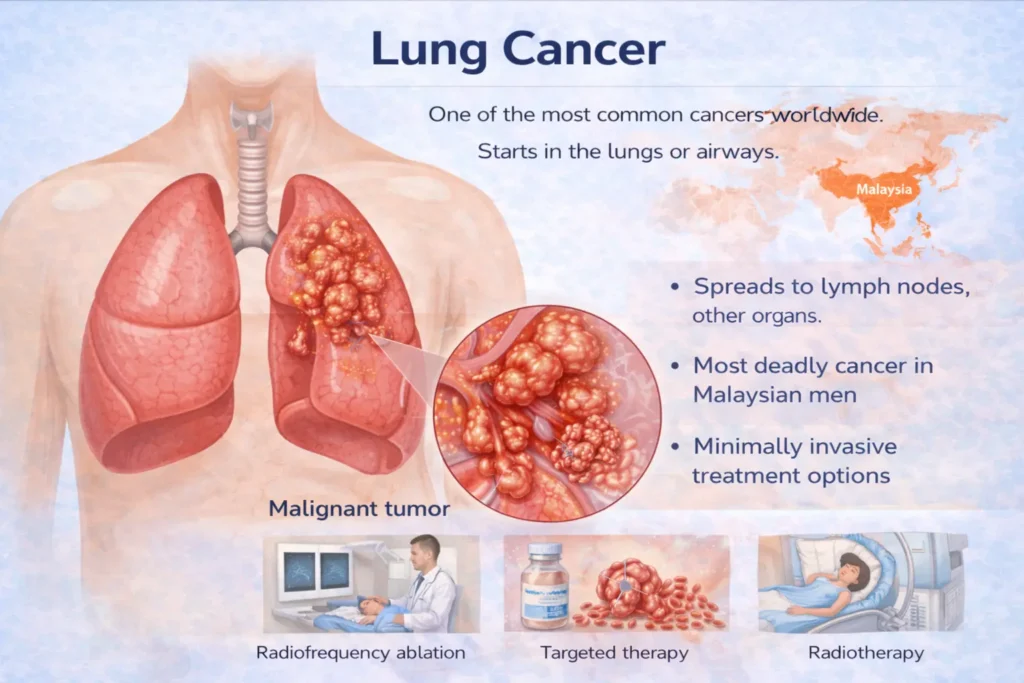
Lung cancer is one of the most common and deadliest types of cancer worldwide. It develops when abnormal cells in the lungs grow uncontrollably, forming tumors that interfere with normal lung function. If left untreated, these cancer cells can spread to nearby lymph nodes and distant organs such as the brain, liver, bones, or adrenal glands.
There are two main types of lung cancer: Non-Small Cell Lung Cancer (NSCLC), which accounts for approximately 85% of cases, and Small Cell Lung Cancer (SCLC), a more aggressive form that tends to spread rapidly. Smoking remains the leading risk factor, but lung cancer can also occur in non-smokers due to genetic factors, air pollution, radon exposure, secondhand smoke, or occupational exposure to harmful substances.
Early detection plays a crucial role in improving treatment outcomes, as lung cancer often develops without noticeable symptoms in its initial stages.
PRECISE CANCER ASSESSMENT
Comprehensive Lung Cancer Diagnosis
Diagnosing lung cancer involves several tests to confirm the presence of cancer and determine its stage. These may include:
- Physical examination and medical history
- Chest X-ray
- Computed Tomography (CT) scan
- Positron Emission Tomography (PET-CT)
- Magnetic Resonance Imaging (MRI)
- Bronchoscopy
- Needle biopsy or surgical biopsy
- Sputum cytology
- Molecular and genetic testing
Once cancer is confirmed, staging is performed to determine the size of the tumor, lymph node involvement, and whether the disease has metastasized.
Accurate staging enables specialists to develop the most appropriate and personalised treatment plan.
RECOGNISE THE WARNING SIGNS
Common Symptoms of Lung Cancer
Lung cancer symptoms often do not appear until the disease has progressed. However, common warning signs include:
- A persistent cough that does not improve or becomes worse
- Coughing up blood or blood-stained mucus
- Chest pain that worsens with deep breathing or coughing
- Shortness of breath or difficulty breathing
- Wheezing
- Hoarseness or changes in voice
- Recurrent lung infections such as pneumonia or bronchitis
- Unexplained weight loss
- Loss of appetite
- Persistent fatigue or weakness
When lung cancer spreads to other parts of the body, additional symptoms may develop, including:
- Bone pain
- Headaches
- Dizziness
- Swelling of the face or neck
- Neurological symptoms caused by brain metastases
Because many of these symptoms can also be caused by non-cancerous conditions, medical evaluation is essential for an accurate diagnosis.
Advanced Technologies
Minimally Invasive Treatment Options
Modern Cancer Hospital Guangzhou specialises in minimally invasive cancer treatments that precisely target tumours while minimising damage to healthy tissue.
Depending on each patient’s condition, therapies such as interventional treatment, cryotherapy, microwave ablation, radioactive seed implantation, and other advanced techniques may be combined into a personalised treatment plan designed by a multidisciplinary team (MDT).
This approach aims to maximise treatment effectiveness while improving recovery and quality of life.
Surgery
Surgery is often recommended for early-stage Non-Small Cell Lung Cancer (NSCLC) when the tumour can be completely removed. Procedures may include wedge resection, lobectomy, or pneumonectomy, depending on the extent of the disease.
Chemotherapy
Chemotherapy uses anti-cancer drugs to destroy rapidly dividing cancer cells. It may be administered before surgery, after surgery, or as the primary treatment for advanced-stage lung cancer.
Radiation Therapy
Radiation therapy uses high-energy rays to destroy cancer cells. It can be used alone or in combination with surgery and chemotherapy to improve treatment outcomes.
Targeted Therapy
Patients with specific genetic mutations, such as EGFR, ALK, or ROS1, may benefit from targeted therapy, which attacks cancer cells while reducing damage to surrounding healthy tissue.
Immunotherapy
Immunotherapy enhances the body's immune system to identify and eliminate cancer cells. It has become an important treatment option for many patients with advanced lung cancer.
Get a Free Consultation
Our specialists are ready to review your case and design a personalised treatment plan.
Book Free ConsultationSPECIALIST EXPERTISE
Multidisciplinary Medical Team (MDT)
We break through traditional one-oncologist models. Our MDT approach brings together
experts from radiology, surgery, TCM, and internal medicine to formulate your
personalized plan.

Prof. Song Shijun
Chief Expert of the Oncology Department
Chief Physician • Professor

Prof. Dai Wenyan
Director of Oncology Department · Director of Breast Cancer Center
Chief Physician

Ma Xiaoying
Director of Oncology Department
Associate Chief Physician

Dr. Wang Baoli
Oncology Specialist
Associate Chief Physician
Ready to Begin Your Treatment Journey?
Our patient coordinators are available 24/7 to review your diagnosis, explain which technologies apply, and arrange a free multidisciplinary case review.
Book a Free Consultation