


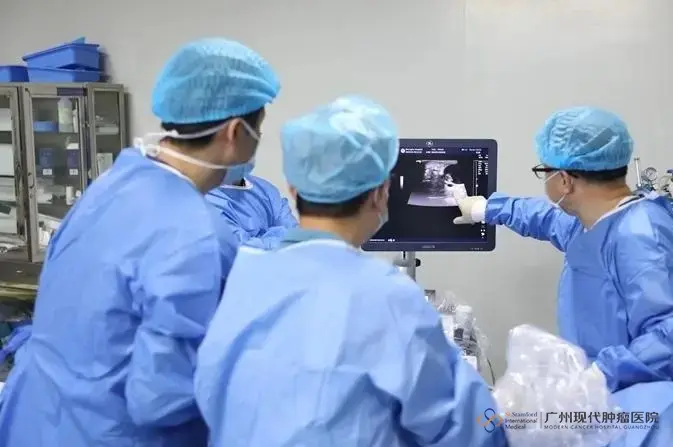
125I Seed Implantation (Particle Knife)
What Is 125I Seed Implantation (Particle Knife)?
Seed implantation therapy, widely referred to as the “particle knife,” is a minimally invasive procedure developed by the international medical community to address the limitations of open surgery and conventional external-beam radiotherapy.
The process begins with calculating the required radiation dose and selecting an appropriate number of particles based on a tumor’s characteristics, size, and location. Guided by real-time imaging, radioactive iodine-125 (125I) seeds are then placed directly into the tumor or into surrounding tissue that has been infiltrated by cancer cells. The gamma radiation continuously emitted by these seeds destroys malignant cells from within, functioning as a form of internal radiotherapy that can achieve outcomes comparable to surgical removal.
Steps in the Particle Implantation Procedure
- The care team determines how many seeds are needed and maps out their placement within the tumor.
- Following local anesthesia, imaging technology is used to pinpoint the tumor’s exact position.
- A specialized implantation needle is guided precisely into the tumor to deliver the seeds.
- Once in place, the seeds emit a continuous stream of gamma radiation that damages the DNA of cancer cells, halting their ability to divide and eventually causing the tumor to shrink and die off.
Who Can Benefit From This Treatment?
Seed implantation may be considered for patients who fall into the following categories:
- Individuals with a primary tumor that has not yet been treated
- Those who decline surgery or are not medically suitable candidates for it
- Patients whose response to external radiotherapy has been poor or unsuccessful
- Cases where the external radiation dose delivered was insufficient and additional local dosing is required
- Patients left with residual tumor tissue after surgery, or where the surgical margin was too close to the tumor (under 0.5 cm)
- Those who experience tumor recurrence after surgery but cannot safely undergo another operation
- Patients with metastatic lesions or isolated post-surgical metastases that are no longer operable
- Anyone seeking to reduce the risk of local or regional tumor spread while strengthening overall treatment outcomes
Cancers That May Be Treated With This Technology
This approach is used across a range of malignancies, including lung cancer, prostate cancer, breast cancer, liver cancer, nasopharyngeal cancer, tongue cancer, parotid gland cancer, tonsil cancer, cervical cancer, and endometrial cancer, among others.
How Seed Implantation Compares to Conventional Radiotherapy
Safety Profile
Seed implantation carries a high safety margin, whereas conventional external radiotherapy is associated with greater risk to the patient.
Tissue Damage
Because the incision required is only millimeters in size and the radiation effect is confined to the implanted tumor itself, healthy surrounding tissue receives far less exposure, resulting in fewer side effects and complications. Conventional radiotherapy, by contrast, inevitably exposes nearby healthy tissue as it passes through the body, which can suppress immune function and cause significant side effects such as nausea, vomiting, diarrhea, and appetite loss.
Radiation Dose Delivered
Since 125I seeds have a limited radiation range and stay continuously and precisely targeted at the tumor, they can deliver a dose 2-3 times higher than what external radiotherapy achieves. Conventional radiotherapy, on the other hand, must cover a wider area and pass high-energy rays through the skin and healthy tissue, meaning less of the dose actually reaches the tumor itself.
Duration of Treatment
A single 125I seed implantation procedure provides continuous, effective irradiation for up to 6 months, significantly cutting down on the number of hospital visits needed. Conventional external radiotherapy typically requires sessions five times weekly over a course lasting 1-2 months.
Treatment Effectiveness
Because the seeds deliver continuous low-dose radiation for up to six months, cancer cells at every stage of their reproductive cycle are exposed evenly, improving overall effectiveness. Conventional radiotherapy is delivered in short, fractionated sessions, which only affects cancer cells that happen to be in a vulnerable phase of their cycle at the time of treatment.
Key Advantages of Particle Implantation Therapy
- High precision — Advanced planning software carefully calculates the number, position, and insertion path of each seed.
- Strong therapeutic outcomes — Radiation is concentrated directly at the tumor site, maximizing effectiveness.
- Sustained action — Continuous irradiation lasting up to 180 days ensures even exposure of cancer cells regardless of their cycle stage.
- Minimal impact on healthy tissue — The radiation only travels between 5mm and 50mm within the body, sparing surrounding tissue from significant exposure.
- High safety standard — Radiation exposure to medical staff and family members remains well below national safety thresholds, since only the tumor site receives localized, low-dose radiation.
- Minimally invasive — Seeds are inserted percutaneously, requiring no traditional incision.
- Strong biocompatibility — Each iodine-125 seed is encased in a titanium alloy shell that the body tolerates well, without triggering rejection or radiation leakage.
- Compatible with other treatments — Can be combined with other therapies to enhance overall results.
- Repeatable — Additional seeds can be implanted later if the initial dose proves insufficient.
- Broad applicability — Suitable for the majority of solid tumor types.
Important Precautions
The radiation from 125I seeds has an effective range of just 1.7 cm, and exposure levels for both medical staff and patients remain well within national safety limits, so there is no cause for radiation-related concern.
For the first two months following the procedure, patients are advised to limit close contact with pregnant women and children under the age of three. After this period, radiation levels taper off naturally and patients can resume normal daily activities.
Because the seed casing is made of titanium alloy, it is unaffected by magnetic fields. This means patients can safely undergo CT scans, MRIs, X-rays, ultrasounds, and other imaging exams as needed after implantation.