


Minimal Invasive Approach Offers New Hope for Advanced Ovarian Cancer Patients
A Journey from Diagnosis to Treatment Challenges
Landriany, a 50-year-old resident of Indonesia, faced a life-altering diagnosis in 2014 when she was confirmed to have ovarian cancer. Her battle with the disease began years earlier, however. In 1998, she started experiencing severe menstrual pain that became increasingly unbearable. Medical evaluation at her local hospital revealed an ovarian issue, leading to the surgical removal of one ovary. While this initial intervention provided relief from the painful periods, it marked the beginning of a longer struggle that would test her resilience and determination.
When cancer developed in her remaining ovary sixteen years later, Landriany underwent surgical intervention to remove the tumor, which measured approximately 6 centimeters. The procedure appeared successful initially. However, the disease proved aggressive and returned within a year, spreading to her pelvis with metastases. Her local physicians, recognizing the severity and complexity of her condition, declined to pursue additional surgery, deeming her situation too risky for conventional surgical approaches.
The Toll of Conventional Cancer Treatment
Facing limited options locally, Landriany’s medical team prescribed chemotherapy as the next course of action. She completed three rounds of chemotherapy, enduring significant physical and emotional strain throughout the process. Unfortunately, rather than controlling the disease, the chemotherapy failed to halt its progression. The tumor expanded from its original 6-centimeter diameter to 11 centimeters, nearly doubling in size. Her cancer classification advanced to stage IV, the most severe designation.
The side effects of chemotherapy compounded her suffering:
- Severe nausea and vomiting that affected her daily function
- Complete hair loss, a visible reminder of her ongoing battle
- Worsening urinary and bowel dysfunction
- Generalized body pain throughout her frame
- Declining quality of life and emotional distress
Despite the intensive treatment, her condition continued deteriorating. Her doctors informed her that traditional surgical options were no longer viable due to the extent of her disease and her overall health status. Landriany felt trapped—conventional medicine appeared to have exhausted its standard approaches, yet her cancer was advancing rapidly.

Discovering an Alternative Path Forward
During this dark period, Landriany learned about Modern Cancer Hospital Guangzhou and their minimally invasive treatment options through newspaper articles and online research. The concept immediately resonated with her—treatments that could target cancer with minimal surgical trauma and reduced side effects. These weren’t the traditional surgery, chemotherapy, and radiation combination she had already endured.
Seeking additional perspective, she visited the Modern Cancer Hospital Guangzhou office in Surabaya, Indonesia for a consultation. When she heard testimonies of other patients—individuals with even more advanced disease than hers—who had achieved meaningful responses to minimally invasive therapy, she decided to take action. In November 2015, she made the courageous decision to travel to China to pursue this innovative treatment approach.
Tailored Minimally Invasive Treatment Strategy
Upon arrival at Modern Cancer Hospital Guangzhou, the multidisciplinary team evaluated her case comprehensively. Based on her specific medical situation, they developed a customized treatment program combining two complementary approaches: interventional therapy paired with microwave ablation.
Interventional therapy functions through targeted image-guided delivery of treatment directly into tumors using only millimeter-scale skin incisions. This technique offers several distinct advantages:
- Precise targeting of cancer tissue with minimal damage to surrounding structures
- Reduced operative trauma compared to traditional surgery
- Lower overall side effect profile
- Particularly effective for patients with advanced-stage disease who cannot tolerate conventional surgical approaches
- Faster recovery times and improved quality of life during treatment
Microwave ablation, the complementary therapy, uses heat energy to inactivate cancer cells with a high success rate. When combined with interventional therapy, these techniques work synergistically to maximize effectiveness while maintaining minimal systemic toxicity.
Treatment Experience and Remarkable Recovery
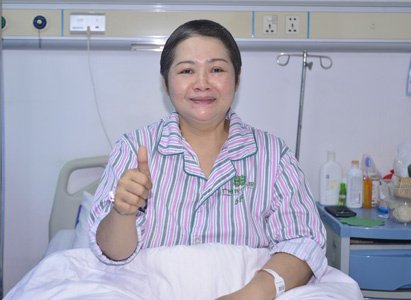
Landriany’s first interventional therapy session occurred in the operating room under local anesthesia, allowing her to remain conscious throughout. She expressed surprise at the brevity and painlessness of the procedure—the entire treatment lasted approximately thirty minutes and caused no discomfort despite her initial apprehension. Following the first intervention, she noticed her tumor beginning to shrink. Hair regrowth started gradually, a physical sign that her body was recovering from the devastating effects of chemotherapy.
Over the course of her treatment, Landriany completed five sessions of interventional therapy complemented by two sessions of microwave ablation. Her response has been remarkable: the tumor shrank from its previous 11-centimeter size back down to 6 centimeters. Her disease is now stable, and her overall condition has stabilized considerably. She no longer exhibits the symptoms that had plagued her—the urinary difficulties, bowel dysfunction, and pervasive pain have improved substantially.

Speaking about her experience, Landriany reflected: “During my first interventional therapy session, because it used local anesthesia only, I remained awake and felt no pain. The entire procedure took just thirty minutes. After treatment, I could see my tumor beginning to shrink. I’ve experienced tremendous improvement, and my hair has started growing back gradually. These minimally invasive treatment options aren’t available in Indonesia—our hospitals only offer surgery, chemotherapy, and radiation therapy.”
Looking Toward the Future
Landriany’s journey from despair to hope illustrates the transformative potential of minimally invasive cancer therapy. When conventional approaches falter and patients face seemingly insurmountable odds, alternative methodologies may offer the breakthrough necessary for improved outcomes. Her recovery demonstrates that advanced ovarian cancer doesn’t necessarily require accepting decline—innovative treatment options exist for those willing to pursue them.
When asked about her aspirations moving forward, Landriany expressed her fundamental desire: “I want to completely eliminate this cancer and return to living a normal life.” Her optimism and positive mindset throughout her ordeal have served as an inner strength. Given the progress she has already achieved through minimally invasive therapy, many believe that her hope-filled vision may indeed become reality in the coming months.