

Vietnamese Grandmother Overcomes Advanced Colon Cancer with Minimally Invasive Care
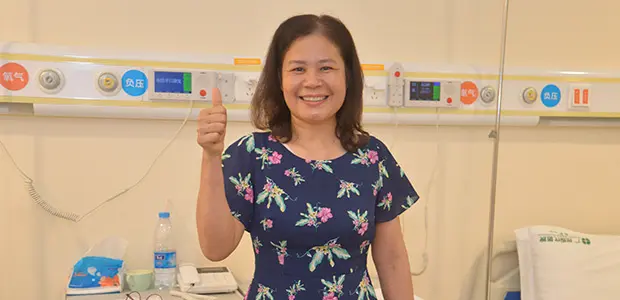
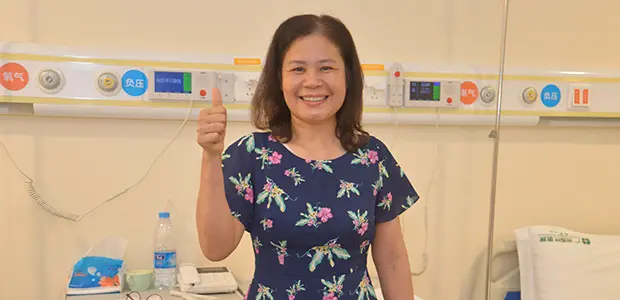
Nguyen Thi Tuoi, a 47-year-old woman from Vietnam, was living an ordinary life surrounded by her family when everything changed in October 2014. Doctors delivered the news that she had colorectal cancer, and she soon underwent both surgery and chemotherapy in her home country. By early 2015, after completing a full course of twelve chemotherapy sessions, her condition appeared stable. For the next year, she remained vigilant, returning for follow-up scans every three months.
An Unwelcome Return
Her sense of relief was short-lived. Toward the close of 2016, blood work revealed elevated tumor markers, and a subsequent PET-CT scan confirmed her worst fear: the cancer had come back and spread to her spleen, forming a mass measuring 1.4 centimeters.
The diagnosis left her shaken and heartbroken. She had already endured so much, and by then she was even a grandmother, looking forward to watching her grandchildren grow. Facing cancer a second time felt overwhelming. Still, the love and support of her family gave her the strength to keep fighting. She pushed through seven more months of chemotherapy, but the prolonged treatment took a toll on her body, leaving her increasingly frail, while the tumor itself continued to grow.
It was at this difficult crossroads that a friend told her about St.Stamford Modern Cancer Hospital Guangzhou. In August 2017, Nguyen made the decision to travel to Guangzhou, China, in search of a different path forward.
Pursuing Minimally Invasive Treatment in Guangzhou
When she first arrived at the hospital, a comprehensive evaluation showed that the splenic tumor had grown further, now measuring 1.2 by 2.1 centimeters. Her case was reviewed by a Multidisciplinary Team (MDT) of specialists, who designed a combined treatment strategy pairing interventional therapy with natural, body-supportive therapy.
How Interventional Therapy Works
Interventional therapy involves threading a fine catheter—less than 2 millimeters wide—directly into the blood vessel feeding the tumor. Through this catheter, doctors deliver an embolic agent that cuts off the tumor’s blood supply, effectively causing it to starve. At the same time, anticancer medication contained in the embolizing agent is released gradually and directly into the tumor site.
Because Nguyen’s body had already been weakened by extended chemotherapy in Vietnam, this targeted approach was particularly well suited to her situation, since it could attack the tumor without placing further strain on her system. Over roughly seven months of treatment and recovery, her health steadily improved. Follow-up PET-CT imaging eventually showed that the splenic tumor had shrunk enough to make surgery a viable option. On March 26, 2018, she underwent surgical removal of the tumor, and within a month her body had healed remarkably well.
Gratitude, Hope, and a New Outlook on Life
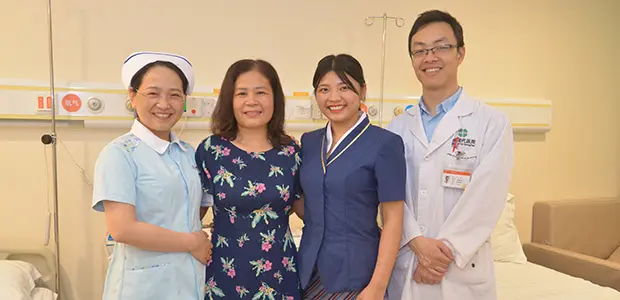
Before making the trip, Nguyen had worried about language barriers and the general difficulty of navigating treatment in an unfamiliar country. Those fears faded quickly, however, thanks to the warmth and dedication of the hospital’s doctors, nurses, and interpreters, who made her feel cared for as though she were at home.
Speaking on behalf of her whole family, Nguyen shared her deep appreciation for the medical team that helped restore her health and give her life back. She offered heartfelt wishes for recovery and happiness to everyone walking a similar path.
Reflecting on her years-long journey against cancer, she said the experience renewed her appreciation for life itself. Her message to other patients is simple: keep fighting, and never give up the battle against cancer.