


Avoiding Surgery: How Minimally Invasive Care Helped My Tongue Cancer
A Warning Sign That Wouldn’t Go Away
Back in 2014, Eva Jessica first noticed something odd — she kept accidentally biting her own tongue while eating. At first she brushed it off as nothing serious. But when the problem persisted for several months, she sought medical checkups in Indonesia. Those early tests, however, came back without any clear findings.

It wasn’t until 2018 that things took a turn. The tongue-biting episodes grew more frequent, and Eva began noticing stiffness and a change in the shape of her tongue. Seeking answers, she visited a cancer hospital in Malaysia, where doctors delivered a difficult diagnosis: stage III tongue cancer. Surgeons recommended surgical removal of the affected tissue, but Eva hesitated. The prospect of significant physical trauma and the practical difficulties that would follow made her reluctant to accept the operation.
Exploring Options Beyond the Operating Table
Determined to find another path, Eva turned to the internet and came across St. Stamford Modern Cancer Hospital Guangzhou. What caught her attention wasn’t just the hospital’s reputation, but the range of treatment technologies it offered. Beyond conventional surgery, she learned the hospital provided several minimally invasive approaches for tongue cancer — options known for causing less tissue damage and fewer side effects.
Her search eventually led her to the hospital’s representative office in Jakarta. Learning that the staff there could guide her through the entire process of traveling abroad for treatment — including arranging pickup services once she arrived in China — put her mind at ease. Eva later admitted that she had gone into the decision with some hesitation and worry, but those concerns faded once she realized the hospital’s team would handle the logistics for her.
Treatment That Felt Like a Mosquito Bite
Eva arrived at St. Stamford Modern Cancer Hospital Guangzhou on April 11, 2018. After a full round of diagnostic testing, a multidisciplinary team of specialists put together a treatment strategy combining interventional therapy, iodine-125 particle (seed) implantation, and supportive natural therapy.
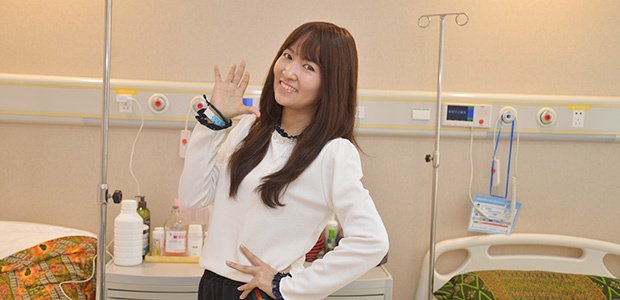
Going into her first procedure, Eva knew very little about what minimally invasive therapy actually involved, and she was bracing herself for significant pain. The reality turned out to be far different from what she had imagined.
She underwent her first interventional therapy session on April 13. Within three days she was able to shower normally, and the site of the procedure resembled little more than a mosquito bite — barely visible. Just one day after treatment, she was walking around without difficulty. She described the entire process as fast and essentially painless.
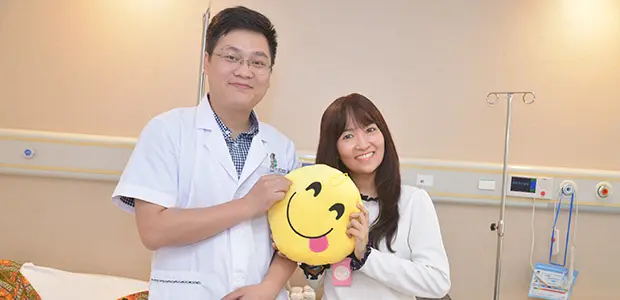
On April 18, Eva began her first round of particle implantation. She recalled some initial discomfort when this treatment started, but as the tumor gradually became smaller, that discomfort faded away as well. Along with it, her earlier symptoms — the tongue stiffness and trouble eating — eased significantly. By the time she shared her story, she described her condition as having returned to normal.
Her attending physician, Dr. Yao, reported that follow-up CT scans showed the area where the radioactive seeds had been placed was largely inactive, with the remaining tumor reduced to about 1cm. The doctor expected continued positive results as treatment progressed.
How the Combined Therapy Works
Dr. Yao explained the rationale behind pairing these two techniques for patients who decline surgery:
- Interventional therapy delivers medication directly to the tumor site at a concentration several times higher than standard systemic chemotherapy — roughly 2 to 8 times stronger — while creating a wound of only about 2mm.
- Because the drug is targeted so precisely, it can destroy cancer cells while sparing much of the surrounding healthy tissue.
- Particle implantation, sometimes referred to as the “particle knife,” involves placing iodine-125 seeds that continuously emit low-level gamma radiation directly into the tumor, steadily destroying cancer cells from within.
- Used together, doctors say the two methods can achieve outcomes comparable to surgical removal, while keeping discomfort to a minimum.
Finding Confidence Through Support
Eva didn’t pretend the journey was free of emotional ups and downs. She described moments of worry and frustration during her course of treatment. What made the difference, she said, was the patience of the medical staff — doctors and nurses who took the time to answer every question she raised, offering reassurance and encouragement along the way. Reflecting on her experience before being discharged, she credited that sense of care and support as a major source of strength in facing her illness.
Disclaimer: Individual treatment outcomes vary from patient to patient. This account reflects one patient’s personal experience and should not be taken as a guarantee of similar results for others, nor as a substitute for professional medical advice.