

Beyond Surgery: How Minimally Invasive Treatment Transformed One Woman’s Battle with Endometrial Cancer
Initial Diagnosis and Surgical Disappointment
Yati, a patient from Jakarta, Indonesia, began experiencing concerning symptoms in May 2018. Persistent abdominal discomfort and swelling developed in her lower right abdomen, accompanied by severe menstrual pain. Seeking medical evaluation at a local Indonesian hospital, diagnostic imaging revealed masses in her ovarian region. Following the medical team’s recommendation, she underwent surgical intervention.
The pathological analysis following the procedure confirmed a diagnosis of endometrial cancer—devastating news that left her family struggling to process the reality. Initially hopeful that surgery would resolve the malignancy completely, the family’s optimism quickly faded as post-operative recovery brought no relief. Instead of improvement, Yati continued to experience ongoing abdominal pain and bleeding complications.
The lack of improvement prompted her to seek alternative treatment options elsewhere. Regrettably, a second surgical opinion resulted in recommendation for another operation, hoping to achieve better outcomes. However, this additional procedure also failed to address her deteriorating condition. Two consecutive surgical attempts had yielded no meaningful progress, leaving Yati emotionally and physically exhausted.
“I was constantly overwhelmed with despair,” Yati reflected on those difficult months. “I struggled with depression, uncertain whether I would ever feel healthy again.” The traditional surgical approach had provided no solution to her advancing disease. It became evident that a fundamentally different treatment strategy was necessary.
Discovery of Advanced Treatment Options
Desperate to find answers, Yati’s husband undertook extensive online research investigating contemporary cancer treatment modalities. His search led the family to St. Stamford Modern Cancer Hospital Guangzhou, a facility specializing in innovative cancer care approaches. Accompanied by her spouse, Yati visited the hospital’s Jakarta office to learn about their treatment programs and technological capabilities.
During the consultation, medical professionals explained the advantages of minimally invasive therapeutic approaches. “When I arrived for the consultation, I was experiencing severe abdominal pain and felt extremely unwell,” Yati explained. “Learning about treatment options that could address my cancer while causing significantly less trauma to my body than surgery gave me genuine hope for the first time in months.”
The Jakarta office staff shared encouraging success stories from Indonesian patients who had previously received minimally invasive therapy and experienced substantial clinical improvements. Witnessing the positive outcomes achieved by fellow patients from her home country convinced Yati that pursuing treatment in China was worth the commitment. She resolved to travel to the hospital’s main facility in Guangzhou for comprehensive cancer treatment.
Comprehensive Treatment and Transformation
On August 12, 2018, Yati and her husband arrived at St. Stamford Modern Cancer Hospital Guangzhou ready to begin treatment. A specialized multidisciplinary medical team, after thorough assessment of her condition and diagnostic imaging, designed an individualized treatment strategy combining interventional therapy with particle implantation techniques tailored specifically to her clinical presentation.
The prospect of undergoing interventional therapy initially generated considerable anxiety for Yati. However, the compassionate clinical staff provided reassurance and thorough explanation of the procedure, which significantly reduced her apprehension before treatment commenced.
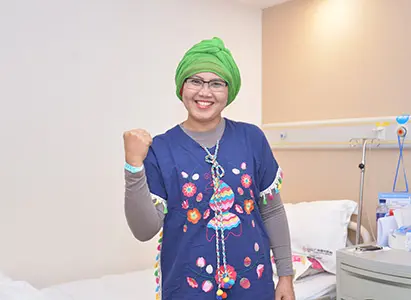
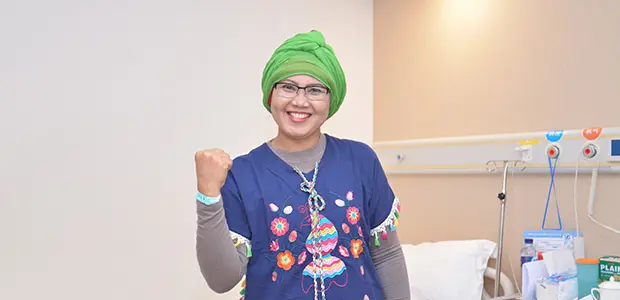
The results exceeded her expectations. “The abdominal pain that had plagued me for so long disappeared after the initial intervention session,” Yati reported. “As I completed five total interventional therapy sessions combined with the particle implantation procedure, I noticed dramatic improvements in my overall wellbeing.”
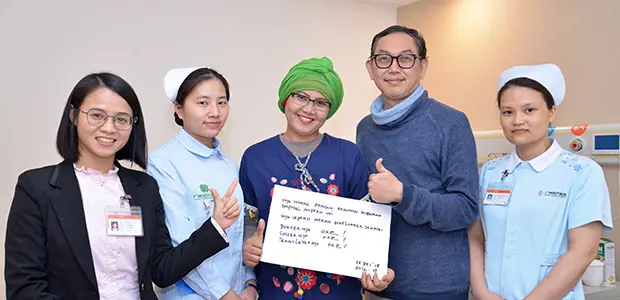
The contrast between her experience with minimally invasive therapy and her previous surgical interventions in Indonesia was striking. “Compared to my surgical procedures, this treatment approach created minimal discomfort and produced substantially fewer systemic side effects,” Yati observed. “My appetite returned, I gained weight steadily, and my energy levels improved considerably. My physical condition became remarkably good—better than I had felt in years.”
Remarkably, the combined therapeutic approach achieved what two surgeries could not: complete resolution of her disease. Following completion of the interventional therapy and particle implantation sessions, imaging studies confirmed that the enlarged lymph nodes in her pelvis and the tumor involving her rectum had completely disappeared. For the first time since her diagnosis, Yati achieved stable clinical status with complete disease remission.
Gratitude and Message to Other Patients
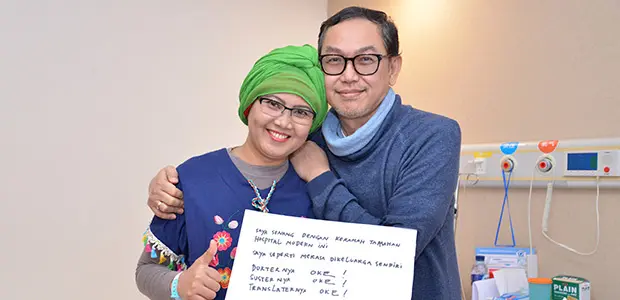
As her discharge date approached, Yati felt compelled to express profound gratitude toward the institution and its personnel. “I want to sincerely thank the hospital for restoring my life and giving me happiness again,” she stated emotionally. “I am equally grateful to every member of the medical team—the physicians, nursing staff, and interpreters who provided exceptional care and support throughout my treatment journey.”
Beyond thanking her care team, Yati wanted to offer encouragement to others facing similar cancer diagnoses. “To every person battling cancer, my message is simple: maintain your courage and never surrender,” she said with conviction. “You absolutely can overcome this disease. Continue to fight, and you will achieve recovery. I wish every cancer patient the strength and successful treatment outcomes they deserve.”